columnOn Liberty
How protest policing can give opponents a veto
A High Court permission decision leaves an awkward question about who bears the cost when rival demonstrations repeatedly confront one another.
- Printed
- Filed
- On Liberty
- Form
- column
- Reading
- 5 min
On 7 May 2025, Deputy Assistant Commissioner Adelekan imposed a condition preventing an IJAN-UK protest from assembling in a specified area of Swiss Cottage. I think the decision exposes a danger in public-order policing: confrontation can give opponents an effective veto over a protest’s location, without any officer or counter-protester intending that result.
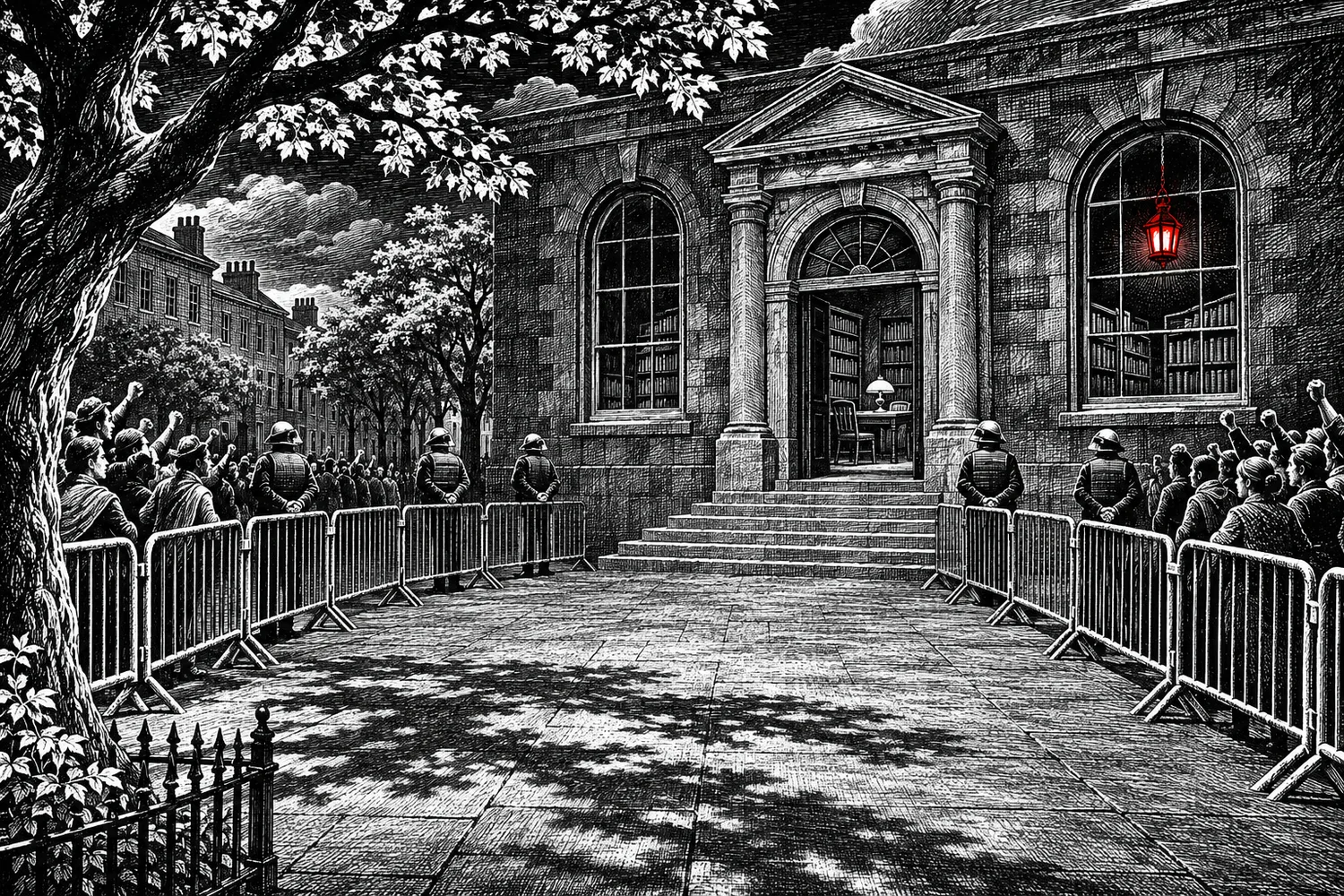
The mechanism is simple enough. A group chooses a place because the people it wants to address are there. Opponents turn up. The encounter becomes difficult to police, neighbours complain, and the cumulative disruption becomes intolerable. The police move the original group. The opponents need not have broken the law, acted together or set out to force that outcome. But if confrontation helps make the chosen place unavailable, the practical reward goes to those who opposed the assembly there.
That is a risk, not a finding that a veto was exercised in Swiss Cottage. The approved judgment of Mr Justice Sweeting records a dispute about who caused particular incidents. It does not settle that dispute incident by incident, and it does not quantify the complaints, arrests or disruption on which the police relied. The distinction matters: the right to counter-protest is not a licence to disrupt, but neither is the act of counter-protesting itself evidence of disruption.
Sweeting refused Janet Simon permission to seek judicial review on 22 September 2026. He did not conduct a full judicial review hearing or finally determine whether her rights had been infringed. He found no proposed ground with a realistic prospect of success. His judgment says the police were entitled to consider the cumulative effect on the community, even assuming that opponents caused some or much of the disruption.
Simon is a Jewish Camden resident and a regular participant in the International Jewish Anti-Zionist Network UK demonstrations. Her counsel, Alex Goodman KC, argued that the place was part of the message: the protesters wanted to address the local Jewish community about Judaism, Zionism and Israel. Sweeting accepted that the location deserved substantial weight. Being allowed to protest somewhere else was not the same thing as being able to speak to the intended audience.
The history is not one of a police commander instantly yielding to a noisy crowd. Sweeting records earlier restrictions, relocations and conditions on both groups. The protesters returned to Swiss Cottage on 2 May 2025, after demonstrating outside New Scotland Yard, and conditions were again imposed on both sides. The condition Simon challenged was Adelekan’s decision of 7 May 2025; later conditions were separate decisions, not automatic renewals.
A street is also where people live.
Chief Superintendent Jason Stewart said, as reported by Jewish News, that the protests had caused fear and concern linked to antisemitic hate crime, and that officers had seen hate speech, intimidation and confrontation. Stewart said relocation was the only way to prevent the level of disruption. Those are serious police characterisations, not findings that every IJAN-UK participant acted unlawfully. They are also reasons to ask what each incident involved, rather than treating all of it as an undifferentiated product of opposing crowds.
The incentive for a public-order commander is to make the immediate problem manageable. A condition moving the assembly offers a clear action and a defensible account of reduced risk. If it also moves the speakers away from the audience they chose, that cost is borne by people with less influence over the policing decision. Residents and organisations who wanted the event moved may benefit, if relocation reduces disruption. The police benefit from a restriction that survived this challenge. None of that requires a conspiracy, or proves that the decision was unlawful.
Goodman proposed alternatives including another site within Swiss Cottage, limits on time or noise, designated areas and better separation. Sweeting found that decision-makers had recognised the importance of the location and considered alternatives over a lengthy period; he did not find an arguable defect merely because other measures might have been adopted. That is a substantial answer to Simon’s legal claim. It is not an experiment showing that each less restrictive option would have failed.
I want Adelekan to publish the decision record, the condition and map, the alternatives assessed and the underlying equality materials, with necessary redactions. What did officers expect each option to achieve, and why was the chosen boundary necessary? The judgment says the decision included an express proportionality assessment; the public should be able to examine the reasoning behind it. Simon and the police also disputed whether organisers had engaged with officers. The liaison correspondence could illuminate that dispute.
I would ask IJAN-UK participants whose accounts are absent from the judgment which incidents they witnessed, what arrangements they proposed and what access to the local audience they lost. I would ask residents, including those who welcomed relocation, whether the disturbance actually lessened, and whether trouble moved elsewhere. I would ask counter-protesters what they observed, what conditions they faced and which separation measures they would accept. The incident logs, complaints, arrest records and available video should be tested against those accounts, not treated as substitutes for them.
If those records show that disruptive opponents were effectively controlled, that workable lesser restrictions were genuinely assessed and that relocation materially reduced serious disruption, my objection to this decision would weaken. If instead police repeatedly counted confrontation against the assembly without adequately addressing its source, the lesson is more troubling. A protest right that survives only at an address chosen for its inconvenience is a diminished right.
The case against this column
The strongest case against me starts with the people who had to live there. A recurring demonstration near homes and places of worship can impose a serious burden even when no single incident tells the whole story. Residents may hear amplified speech, alter their routes or fear a confrontation; they should not have to wait for a court to attribute every episode before police act to protect community life. Stewart’s account of hate speech and intimidation also gives the police more to consider than the mere existence of opposing views.
The police had not simply moved the first group at the first sign of disagreement. Sweeting’s judgment records a prolonged period of public-order management, earlier relocations and conditions imposed on both protesters and counter-protesters. Experienced officers assessed proportionality, and the judge found no realistically arguable legal defect. Separating groups or changing the time and noise limits might have left neighbours exposed to unacceptable disruption. A counter-protest is itself protected expression; controlling it does not mean removing everyone who objects to IJAN-UK.
On that account, relocation was not a reward for disruptive opponents but a proportionate response to an accumulation of harms, while leaving the group free to demonstrate elsewhere. The evidence capable of establishing that account more convincingly is precisely the evidence I want examined: what happened, what was tried, why the alternatives were rejected and what changed after the move.
Signed
Cassandra
The signature is a house pen-name: a shared byline, not a person. See the rules.
MarkedProtest rightsMetropolitan PoliceSwiss Cottage