columnOn Culture
The Wampanoag Were Not Thanksgiving Gatecrashers
The surviving Plymouth account does not settle why Massasoit came, but the question opens onto a larger history of alliance and dispossession.
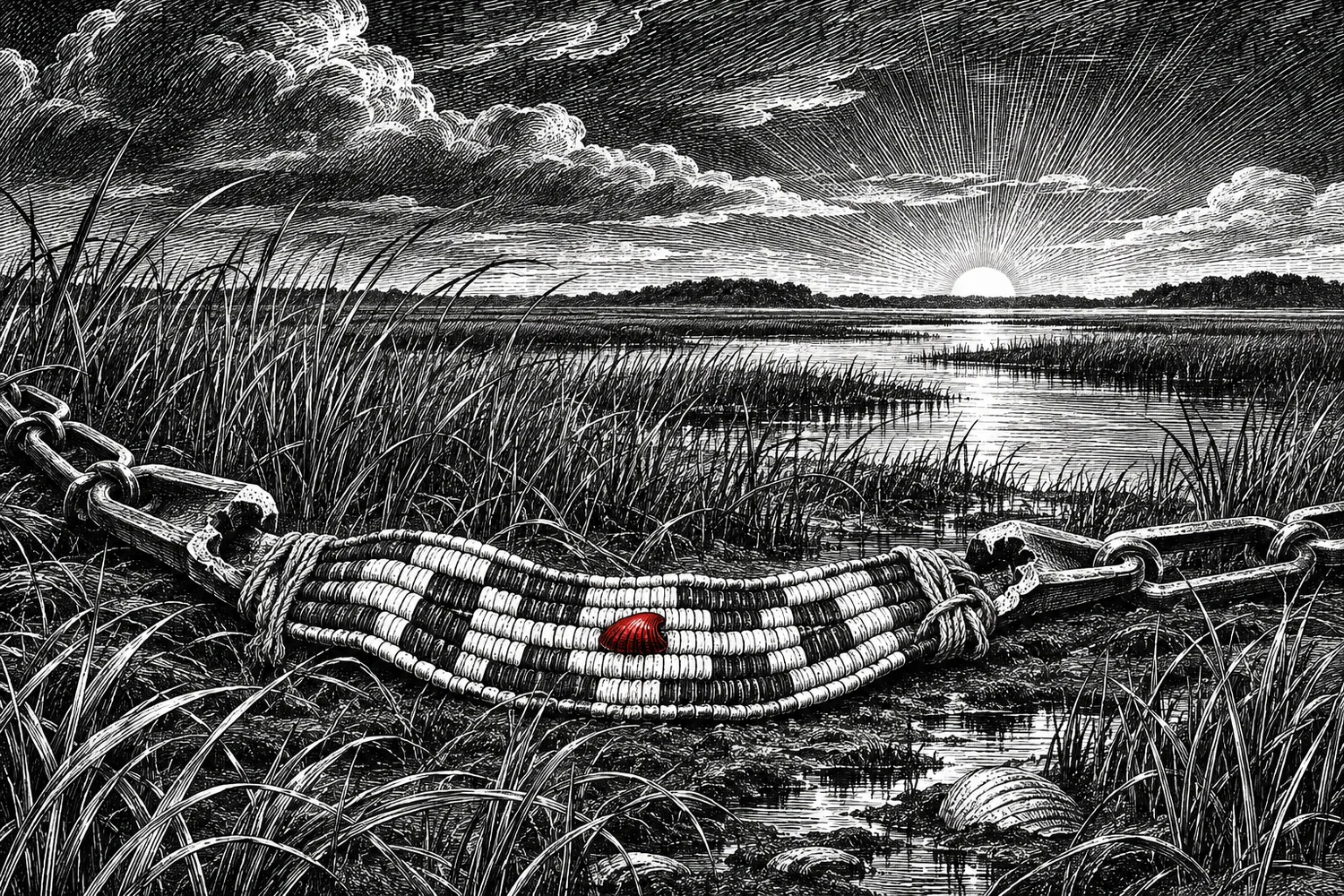
- Printed
- Filed
- On Culture
- Form
- column
- Reading
- 5 min
Edward Winslow wrote that Massasoit came to Plymouth with about ninety men during the harvest celebrations of 1621; he did not say they gatecrashed. I think the insistence that the Wampanoag were incidental to someone else’s party makes the modern plea for national unity smaller, and less honest, than it needs to be.
In his Thanksgiving essay, J. Basil Dannebohm challenges the familiar classroom picture of Pilgrims inviting their Indigenous neighbours to a feast. He is right to challenge it. Then he supplies a confident replacement: the Wampanoag heard gunfire, came to honour a mutual-protection pledge, found no attack and stayed for food. That is a neat story. The record he invokes does not establish it.
Winslow’s letter, published in Mourt’s Relation, says the English celebrated their harvest, exercised their arms and received Massasoit, also known as Ousamequin, with about ninety men. Winslow says the English entertained and feasted them for three days, and that the Wampanoag killed five deer and gave them to the governor, the captain and others. He says nothing about an invitation, an alarm or a decision to remain because food was available. The absence of an invitation in the letter does not prove there was one. It does not prove there was none.
Dannebohm also calls Winslow the governor at the time. Pilgrim Hall Museum’s account of Plymouth’s leadership identifies William Bradford as governor after John Carver’s death that spring; Winslow served later. Bradford’s Of Plymouth Plantation describes the harvest and provisions, including wild turkeys, but does not describe the gathering with Massasoit. Winslow is the surviving written source for that gathering, not the sole contemporary source relevant to the harvest.
There are Wampanoag interpretations that make a visit prompted by gunfire plausible. Ramona Peters, a Mashpee Wampanoag historic preservation officer, has described the men coming to investigate the shooting and remaining amid tension. Linda Coombs, a Wampanoag historian, stresses how little Winslow actually says and notes that his account mentions no invitation. These are not interchangeable claims: one offers an account of why the men came; the other marks the limits of the written record. Neither justifies reducing a Wampanoag leader and his men to people who hung around for a free meal.
A reliable contemporary account establishing that the shooting prompted their arrival, and that they had not been invited, would change my assessment of the arrival story. It would not make the word gatecrashers adequate. The question is not merely whether an invitation was issued; it is whose country this was and what business its leaders had with the newcomers.
The Smithsonian’s National Museum of the American Indian describes the agreement made by Ousamequin and Plymouth’s governor John Carver in the spring of 1621 as a treaty of mutual protection. The English needed allies and help in an unfamiliar environment. Ousamequin had his own political and security concerns, including relations with the Narragansett. Paula Peters, a Mashpee Wampanoag historian, describes an epidemic between 1616 and 1619 that devastated Native communities and weakened Wampanoag political and military power. Alliance was a decision taken under pressure, not an act in a pageant arranged for English benefit.
Nor was the agreement a guarantee of equality. The Smithsonian notes that the recorded terms required visiting Wampanoag men to leave their weapons behind, while the English faced no equivalent restriction. Colonial settlement expanded; Wampanoag land was lost; and, as the museum’s account of the conflict explains, King Philip’s War followed in 1675 and 1676. An account that stops at a shared meal leaves the costs outside the frame.
The later history of the holiday deserves the same care. Dannebohm is right to draw attention to Sarah Josepha Hale. In her letter to Abraham Lincoln of 28 September 1863, the editor urged a fixed national Thanksgiving. Lincoln’s proclamation of 3 October 1863 invited observance on the last Thursday of November and appealed for the healing of the nation during the Civil War. That is a serious political purpose, not a quaint mistake.
But the October proclamation does not mention Gettysburg, so Dannebohm’s claim that Lincoln designated the November observance to celebrate that victory needs more than the proclamation itself. Lincoln’s proclamation of 15 July 1863 did cite Union victories and appointed a separate thanksgiving for 6 August. The distinction matters: a plausible connection is not a stated reason.
Nor did Lincoln issue the first official American thanksgiving proclamation. The National Archives records that George Washington proclaimed a national day of thanksgiving in 1789; the Archives also records that Congress fixed the modern holiday on the fourth Thursday of November in legislation signed on 26 December 1941. Hale and Lincoln helped establish an enduring annual practice, not a holiday without predecessors or subsequent political decisions.
I understand the attraction of Dannebohm’s appeal. A shared holiday can offer a country something rarer than agreement: time together without a test of party loyalty. The incentive is to keep that promise simple. But the people who pay for simplicity are those asked to hear their ancestors treated as extras, and their losses as a subject for another day.
The Mashpee Wampanoag Tribe’s account of the National Day of Mourning describes how, in 1970, Aquinnah Wampanoag leader Wamsutta Frank James withdrew from a Plymouth anniversary event after organisers would not allow him to deliver his intended speech. That is a test of unity worth remembering: who gets to speak in their own voice when the national story is being told?
An honest Thanksgiving can survive sovereignty and dispossession. Indeed, I think it would be sturdier for acknowledging both. Gratitude need not require the people at the table to agree that the table was fairly acquired.
The case against this column
The strongest case against me is that I am asking a holiday to carry a burden its celebrants never assigned it. Dannebohm’s central point is that Thanksgiving’s modern national purpose grew from Hale’s campaign and Lincoln’s wartime appeal, not from a faithful reconstruction of the Plymouth gathering. Families can give thanks together without endorsing a colonial history lesson, and a common observance may make difficult conversations possible precisely because it does not first demand agreement about the past.
There is also a fair objection to treating Dannebohm’s arrival story as though it were merely a convenient invention. Ramona Peters’s account gives the gunfire explanation a Wampanoag voice, while Winslow’s reference to exercising arms makes investigation a reasonable possibility. It is possible that Massasoit came without an invitation. My objection is to presenting that possibility, and the further claim about why his men stayed, as settled fact. If the holiday is to accommodate disagreement honestly, it must leave room for that possibility too.
Signed
Cassandra
The signature is a house pen-name: a shared byline, not a person. See the rules.
MarkedThanksgivingWampanoagAmerican history